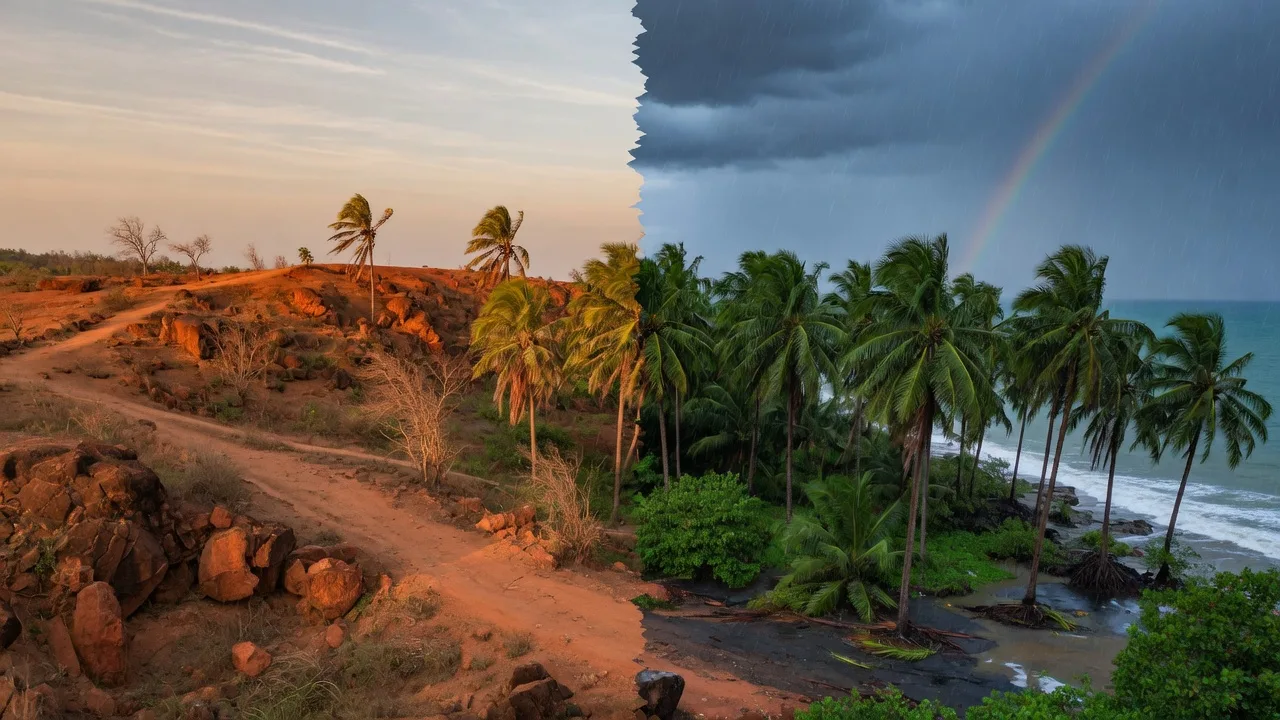
Thailand sits entirely in the tropics, roughly 6°N to 20°N. Most of the country is tropical savanna (Köppen Aw); the south and the Andaman face tropical monsoon (Am). There is no European winter. There is a cool season, a hot season that can pass 40 °C, and two monsoon clocks that do not agree with each other. That disagreement is why you can still find a beach in July — on the Gulf, not the Andaman.
Travel planning that treats “Thailand” as one weather app is how people book Phi Phi in September. Companion pages: Monsoon seasons, Which coast, Gateway When to visit.
Three seasons (the brochure version, then the caveats)
Hot season (March–May)
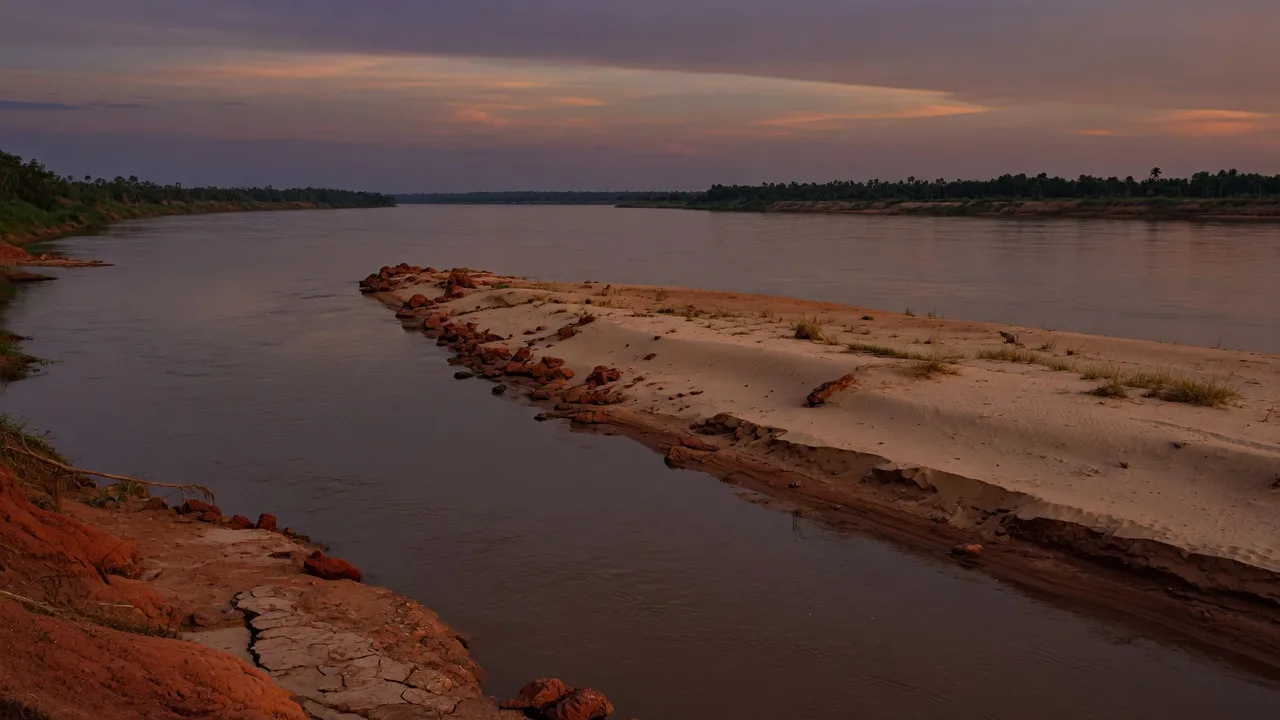
The northeast monsoon has left. The southwest has not arrived. Central plains and northern valleys regularly exceed 40 °C. Bangkok can feel like a wet blanket. This is also Songkran: 13–15 April 2026 — water festival as public-health strategy. People & Spirit: Songkran.
Northern haze from agricultural burning and forest fire is not a mood. Chiang Mai in March–April can post PM2.5 many times the WHO guideline. If you have lungs that complain, this is not your month for the north.
Rainy season (May/June–October on most of the map)

Southwest monsoon off the Indian Ocean. Rain is often an afternoon or evening burst, not British drizzle. Mornings can be hard blue. Then a cumulonimbus.
Rainfall is not one number:
| Region | Annual rainfall (order of magnitude) | Wettest month (typical) |
|---|---|---|
| Bangkok | ~1,500 mm | September |
| Chiang Mai | ~1,200 mm | August–September |
| Phuket (Andaman) | ~2,300 mm | September |
| Ko Samui (Gulf) | ~1,800 mm | November (different clock) |
| Isan | ~1,200 mm | August |
| Ranong (Andaman) | 4,000 mm+ | June–September |
Ranong is one of the wettest corners of Southeast Asia. If your Andaman fantasy is a dry September, it is not Ranong.
Cool season (November–February)
Northeast monsoon: drier air from China. Lowlands 25–32 °C, lower humidity, clearer skies. Peak tourism, for cause.
In the mountains, the air is a different country. Doi Inthanon (2,565 m) regularly sees near-freezing. Chiang Rai and Chiang Mai nights can sit 10–15 °C. Locals in fleeces are not performing winter. Doi Inthanon.
Regional climate
North (Chiang Mai, Chiang Rai, Mae Hong Son)
The widest temperature range in the country. Hot season can reach 42 °C; mountain-valley nights in the cool season 5–10 °C. Burning season February–April is the air-quality problem. Cool season is the reason people stay.
Central plains (Bangkok, Ayutthaya)
Hot and humid most of the year. Bangkok’s concrete makes an urban heat island often 3–5 °C above the surrounding countryside. Flood risk in heavy rainy years. The 2011 flood is the cautionary tale, not ancient history. Rivers and waterways.
Isan
The Khorat Plateau has a sharper dry season. Cool-season nights 15–20 °C. Drought is a farming fact. Less rain than the coasts; rice still depends on the monsoon arriving on time.
Andaman (Phuket, Krabi, Phang Nga)
Heavy rain May–October. Dry November–April is the season the photographs were taken in. Seas get dangerous in the southwest monsoon. Mu Ko Similan closed about 16 May–14 October 2026. Andaman coast, Park permits.
Gulf (Samui, Chumphon, Nakhon Si Thammarat)
Different monsoon timing. The Gulf’s hard rain is often October–December (northeast monsoon), when the Andaman is drying. February–September is why people still fly to Samui in the Andaman’s wet months. Best beaches.
Deep south (Pattani, Yala, Narathiwat)
Near-equatorial: smallest temperature swing, rain in more months, closer to Malaysia’s climate than to Chiang Mai’s.
What this means in a suitcase
Thailand is not one climate in a backpack. Cool-season Chiang Mai at night is not a Similan longtail, which is not a BTS carriage. Pack for the week you booked. Gateway: Packing.
A packable rain jacket earns its keep on an Andaman afternoon. A fleece earns it at 2,565 m. Oral rehydration sachets earn it in April. Dioralyte Relief 6 B001DZQ5PK is currently unavailable, Electrorush ORS B0FFMJMB4H is a Flavour/Size Name menu, and SiS Hydro stays rejected, so those three stay unpinned and the search stays a search.
Festival overlay: Loy Krathong 2026 is 24 November — usually a dry-and-beautiful north, a drying Andaman, a Gulf that may still be sulking. Loy Krathong. Buddhist Era 2569 BE = 2026 CE (CE + 543). Thai calendar.
Climate change, without the TED talk
Thailand is exposed:
- Heat: averages up on the order of 1 °C since the 1960s. Bangkok’s recorded 40.1 °C in April 2023 is the figure people cite as a record; extreme days are more common.
- Floods: heavier bursts plus sealed soil. 2011 remains the economic scare story (damage cited above US$40 billion).
- Sea level and subsidence: Bangkok sits on soft clay and is sinking while the gulf rises. “Parts of the city below sea level by 2050” is a planning warning, not a travel slogan.
- Coral: bleaching in 2010, 2016, 2024. Coral reefs.
- Rice: Isan and the central plains do not get to ignore a shifted monsoon.
Park days still have a tariff in the wet: Khao Yai 400 THB, Inthanon 300 THB, Khao Sok HQ ~200–300, Cheow Lan ~300, Similan ~500 when open. Rain does not discount the booth. Park permits.
Next
Monsoon seasons, Which coast, When to visit, Doi Inthanon, Andaman coast.