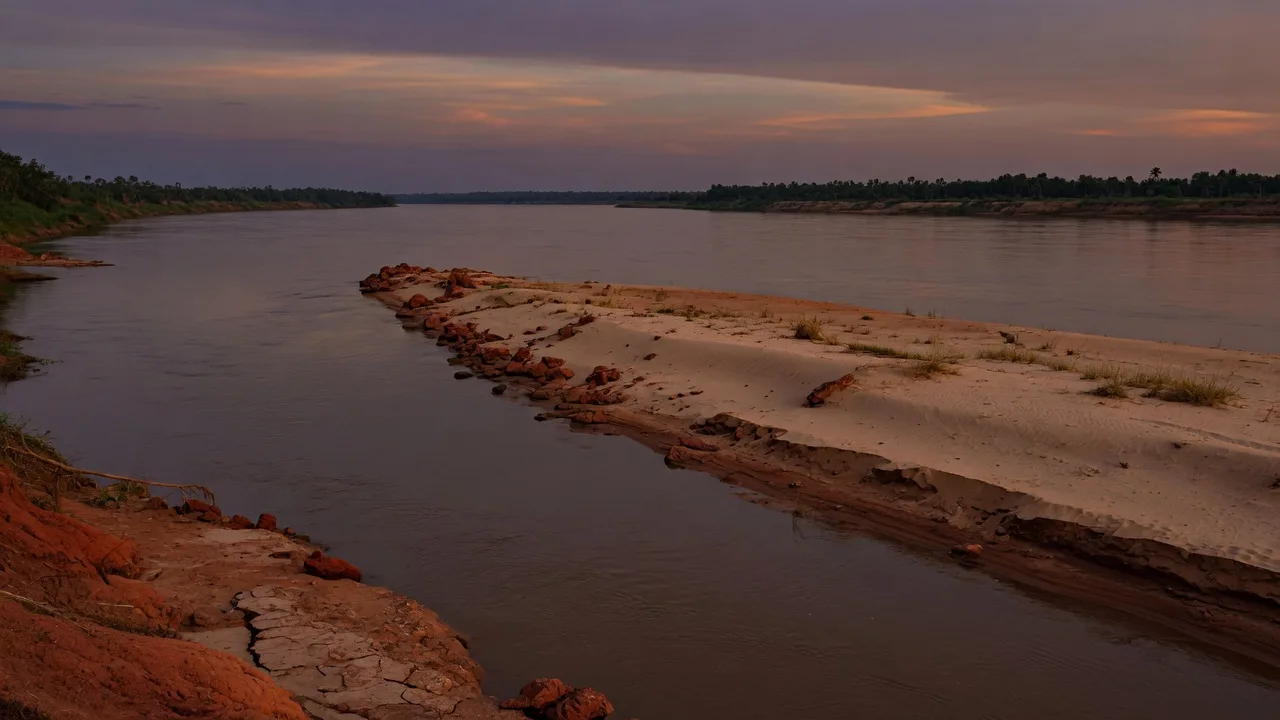
Water built the rice. The Chao Phraya made the central plains. Bangkok’s canals earned the “Venice of the East” line from 19th-century Europeans who had just seen Venice. The Mekong is an 850 km-class border with Laos. Monsoon rain is still the agricultural clock. Flooding is not an accident; it is the basin doing what a flat basin does when the sky opens.
Climate zones, Monsoon seasons. People & Spirit on why a river festival is not just pretty: Loy Krathong (24 November 2026).
Chao Phraya — the national artery
The Chao Phraya (แม่น้ำเจ้าพระยา) forms at Nakhon Sawan where four northern rivers meet — Ping, Wang, Yom, Nan — then runs about 370 km south to the Gulf at Samut Prakan.
The basin covers about 160,000 km² — on the order of a third of the country — and holds the densest population, the rice, the sugar, the fish farms, and Bangkok. Alluvium over millennia made the flat central plain.
Bangkok was founded on a bend in 1782. The Grand Palace, Wat Arun, and the old city’s major wats face the water because the water was the road. The Chao Phraya Express Boat is still a commute, not a tourist toy — though you can ride it as one. Orange-flag boats are the workaday line; tourist boats are a different ticket and a different stop list. Sathorn (Central Pier) is the interchange with the BTS. Gateway: Bangkok, Temple trail.
| Waterway | Pin |
|---|---|
| Chao Phraya length (confluence to sea) | ~370 km |
| Chao Phraya basin | ~160,000 km² |
| Mekong (Thai–Lao border stretch) | ~850 km |
| Mekong total | ~4,350 km source to Vietnam delta |
| Kra Isthmus width | ~44 km Andaman to Gulf |


Mekong — the border that is a river
The Mekong (แม่น้ำโขง) runs 4,350 km from the Tibetan Plateau to Vietnam. Thailand’s Lao border follows it from the Golden Triangle (Thailand, Laos, Myanmar) to Ubon Ratchathani.
Isan’s fisheries and bankside towns still depend on it. Upstream dams in China and Laos change flow, sediment, and fish. That is a diplomatic and ecological fight, not a sunset-cruise footnote.
- Chiang Saen / Golden Triangle — three borders, Lanna ruins, atmosphere.
- Chiang Khong — to Huay Xai and the slow boat toward Luang Prabang.
- Nong Khai — Friendship Bridge to Vientiane; promenade; Sala Kaew Ku; Naga fireballs around the October full moon (unexplained, crowded).
- Nakhon Phanom — quiet bank, Vietnamese community, Lao hills opposite.
- Mukdahan — 2nd Friendship Bridge to Savannakhet; riverside market.
Bangkok’s khlongs
Most east-bank canals were filled and paved. Enough remain to prove the nickname:
- Khlong Saen Saep — east–west express boats; one of the faster ways across the city if you accept the splash. A Fenteer dry bag, black, 10 litre is not overkill. A 20 litre bag is a different listing.
- Thonburi canals — west bank still looks like a city on water: wooden houses, gardens, wats, skyline in the distance.
- Damnoen Saduak — ~100 km southwest, the floating market everyone has already seen. Touristy; still boats selling soup.
- Amphawa — ~75 km south, Friday–Sunday evenings, more local, better seafood.
Table & Bazaar: Floating markets.
North and west
The four tributaries each own a valley:
- Ping — longest; Chiang Mai’s Mae Ping, then Lamphun, Kamphaeng Phet, Nakhon Sawan. Night markets on the bank.
- Wang — Lampang.
- Yom — Phrae, Sukhothai.
- Nan — Nan, Uttaradit.
Kok through Chiang Rai to the Mekong (boat trips). Pai — tubing and gentle rapids that look harmless until they are not.
| River | Control / note |
|---|---|
| Ping | Bhumibol Dam (1964), Tak — still among the country’s largest reservoirs |
| Nan | Sirikit Dam (1974) — paired with Bhumibol for Chao Phraya regulation |
| Mun | Isan’s main river; meets the Mekong at Khong Chiam (Ubon) — two colours of water on a good day |
| Chi | Mun’s big tributary; Roi Et, Yasothon, then the Mun |
| Chao Phraya | Chainat diversion dam; Bangkok’s flood tunnels and pumps sit downstream of all of this |
The northern dams are why the central plain can have both a rice crop and a capital below sea level in places. They are also why a dry-season sandbar on the Mekong and a wet-season flood on the Chao Phraya can be policy arguments, not weather small-talk.
West:
- Khwae Noi and Khwae Yai (River Kwai) — meet at Kanchanaburi. The film name is a mistranslation; the bridge site is on the Mae Klong, later relabelled Khwae Yai for tourism. History is still WWII; the naming is a brochure.
- Mae Klong — to the Gulf at Samut Songkhram; Maeklong Railway Market sits on the tracks.
Mountains and highlands for the valleys these rivers cut.
Flooding
The Chao Phraya basin is flat. Heavy monsoon rain inundates plains; that is hydrology. Bangkok’s canals were flood channels. Dykes, pumps, and tunnels now fight subsidence and a rising gulf.
The 2011 flood was the worst in 50 years: central plain under for months, outer Bangkok at chest height, Ayutthaya industrial estates wrecked, on the order of 800+ deaths, damage cited above US$40 billion. Bangkok also subsides — often cited 1–2 cm/year in the worst pockets — while the gulf rises. Dykes and the King’s tunnels buy time, not a permanent geometry. Climate projections do not suggest 2011 was a one-off. Climate zones.
Park lakes are a different water: Cheow Lan is a 1982 dam, not a holy river. Last boats still win. Khao Sok, Park permits.
A compact umbrella beats a soaked map on a khlong boat. Gateway: Packing, Bangkok.
Chao Phraya, Khlong, Mekong — three jobs
The Chao Phraya is Bangkok’s working river: ferries, tug barges, hotel piers. A tourist boat is fine; the orange-flag river bus is how the city actually moves. Khlong (canals) are the older grid — some still run passenger boats (Saen Saep), many are now roads with names.
The Mekong is the north and Isaan border: brown, seasonal, not for a casual swim. Sandbars in the dry season; a different river in August. Loy Krathong (24 November 2026) is when the water becomes a festival. Do not treat a working channel as a swimming pool.
Longtails on the south are coastal, not riverine. Last boats still apply. Loy Krathong, Getting around.
Next
Landscape overview, Climate zones, Khao Sok, Bangkok, Loy Krathong.